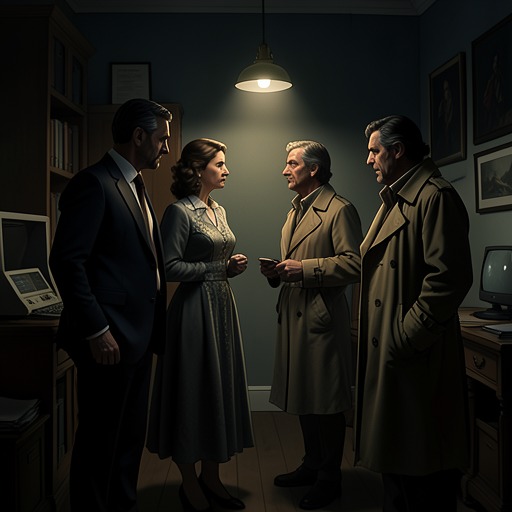
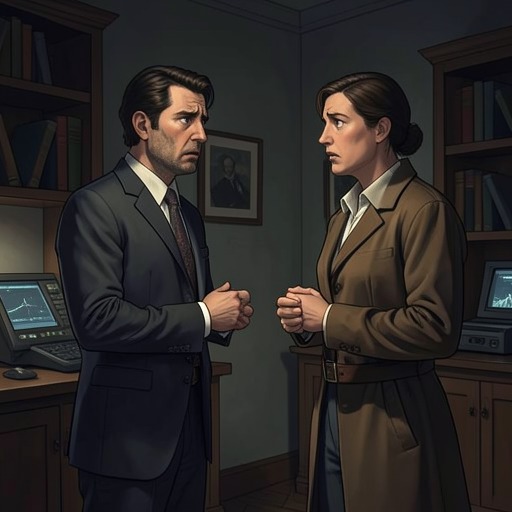
Marion Burgess
My PolicemanMarion Burgess is a schoolteacher, Tom Burgess’s wife, and Patrick Hazlewood’s eventual caregiver. Her account of their intertwined lives turns on the consequences of what she chose to conceal and what she chose to disclose: she sends an anonymous accusation that helps place Patrick in danger, then protects him at trial through a carefully limited answer. In her later narration from Peacehaven, that history becomes not a claim to innocence but a confession of her own part in it.
Identity and First Impressions
Patrick first hears of Marion as a teacher and friend whom Tom is teaching to swim. Tom also says that books are more her line, though they have discussions about many things. When Patrick recognizes that Tom is already planning a future that includes the schoolteacher, Tom describes their relationship as friendship, for the moment, and not serious. Patrick’s account of these early hints reveals his sensitivity to Marion’s presence even before he meets her: he understands that Tom has someone in mind, and guesses that it is the woman previously mentioned.
On 13 December 1957, Tom brings Marion to meet Patrick. Patrick makes an effort to be welcoming, but his account is far from impartial. He notes her height, the heels that do not disguise it, and her conspicuous copper-red hair; he also notices that she does not look away when their eyes meet. He reads her as ambitious and assumes she wants to guide Tom towards a conventional, materially secure future. Those judgments tell as much about Patrick’s jealousy and apprehension as they do about Marion. He chooses the Clock Tower Café, a familiar, unpretentious place where he and Tom eat, partly because he imagines a schoolteacher like Marion would expect somewhere more formal. The meeting is therefore charged by competing interpretations: Patrick sees a possible rival, while Marion’s own perspective will later reveal the marriage and its costs from within.
Marriage and the Triangle
Marion’s retrospective account begins from Peacehaven in November 1999 and looks back to 29 March 1958, the day she married Tom. Rain had hammered the roof that morning. At the time, she imagined it as a kind of baptism into a new life, a cleansing that might wash away the past. Looking back, she gives that hopeful image a more complicated weight: the wedding is a threshold, but not a simple beginning free of what came before.
The ceremony brings Patrick directly into the marriage. He serves as best man instead of Roy, a choice that has caused trouble, and passes Tom the ring that makes Marion Mrs Tom Burgess. Tom wears a grey suit Patrick had bought for him rather than his police uniform. Marion remembers these details alongside the rain-soaked walk from the church and the reception in the church hall. Sylvie attends while pregnant, and Julia Harcourt is there as well; Tom’s parents welcome Marion into the family. The scene’s outward rituals of respectability coexist with the less visible intimacy connecting Tom and Patrick. Marion’s memories preserve both sides: the public wedding and the private significance of Patrick’s presence.
The Letter and Its Consequences
Years later, while caring for Patrick, Marion recalls writing to Mr Houghton, head keeper of Western Art at Brighton Museum and Art Gallery. At four thirty on a Sunday morning, at a table by the window, she seals the letter, addresses it, stamps it, and walks it to the postbox before she can change her mind. She remembers the fall of the envelope into the slot as a moment of cleanness. That physical finality contrasts with the uncertainty she later claims about what she meant to happen.
The letter is signed anonymously as coming from a friend. It identifies Patrick by name and position at the museum, accuses him of being a sexual invert who has committed acts of gross indecency with other men, and presents the accusation as a concern for the safety of schoolchildren and the museum’s reputation. Marion later admits that she knew about prosecutions reported in the newspapers and about the local police’s efforts to repair their reputation after a corruption scandal. She had told herself that she meant only to frighten Patrick, perhaps by bringing him a warning from his employer or costing him his work. Her own recollection exposes the inadequacy of that self-protective explanation: she understood that the consequences could be more serious, even as she focused on exhaustion and the prospect of returning home to tea and sleep.
Testimony and the Limits of Protection
At Patrick’s trial, his barrister calls Marion as a character witness. Patrick had expected that she might know the truth about his relationship with Tom, although Tom had reassured him otherwise. He also calculates that she would not risk denouncing him if doing so could damage her husband and, by extension, herself. These are Patrick’s suspicions, not proof of everything Marion knows; the trial scene keeps that uncertainty in view.
Marion appears in a pale-green dress, wearing white gloves, and gives her name and occupation before describing Patrick’s professional work. She says that he took her pupils for an art-appreciation afternoon at the museum, performed his duties thoroughly, and was good with the children. Her testimony is carefully confined to that professional connection. When asked whether she knows him in any other capacity, she pauses for a long time, looks directly at Patrick, and answers no. She then continues to praise his work with the children. The answer protects a boundary rather than explaining it: it withholds the relationship from the court while affirming a truth about the care he showed her pupils.
Care, Remorse, and Confession
By November 1999, Marion is responsible for Patrick’s daily care. She says she cannot lift him on and off the commode, and describes rising at five thirty to change his waterproof clothing and incontinence pad. Tom is not prepared to help as much as she needs, and she keeps that problem from the nurse because she fears it could put the suitability of their home for Patrick’s care in question. Her body aches from changing sheets, turning and washing him, dressing him, and bringing food to his mouth. Care is not presented as an uncomplicated redemption; it is demanding work undertaken amid fatigue, limited help, and the memory of her own betrayal.
The consequences of the letter become newly immediate when Tom smashes two wooden chairs and then sits, overwhelmed. He tells Marion that he saw Patrick brought in, with Slater holding him by the wrist, and that he fled so Patrick would not see him. Marion understands that, in trying to destroy Patrick, she has also risked destroying Tom. She recognizes that she had not considered what her letter could do to her husband. When Tom asks what he is to do, she decides to become the person who can save him, recalling an earlier image of herself as someone who understood Tom’s weakness.
That decision does not erase the harm or restore the marriage to innocence. When Tom challenges her silence, Marion answers that what she has brought him is not revenge but a confession, and insists that it concerns her own wrongs. Her account thus makes confession more than an explanation of the past: it is her attempt to name responsibility without transferring it to Patrick or Tom. The movement from the anonymous letter to the direct admission gives her narrative its defining tension. She once acted in secrecy and minimized the danger; in old age, speaking plainly becomes the closest she can come to confronting what that act set in motion.